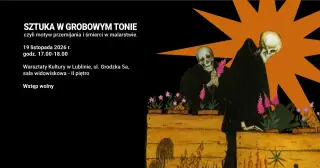
Lecture: Art in a sepulchral tone, or the motif of transience and death in painting
Thursday 19 November, 17:00 · Warsztaty Kultury
- When
- Thursday 19 November, 17:00
- Where
- Warsztaty Kulturyul. Grodzka 7, Lublin
- Admission
- Free admission
In brief
An analysis of the motif of death in painting, from medieval danse macabre, through Baroque vanitas and Romantic visions, to 20th-century works revealing different ways of coming to terms with transience. An art-historical lecture on changing perceptions of death.
Full descriptionHow did the great masters of painting depict the end of life? Does death in paintings have to be dark? How have people come to terms with the thought of the inevitable end of our existence? This autumn, Warsztaty Kultury in Lublin invite you to a slightly darker look at art history.
Looking for an idea for an autumn evening? We have something for you: cushions, art and a topic that can really draw you in. No scrolling, notifications or pressure to get things done. You can simply sit back comfortably, listen and discover a few things you may not have had the chance to think about before. A little journey towards the darker side of painting – relaxing, a little unexpected and perhaps surprisingly enjoyable.
Death is an inseparable part of life and one of the greatest mysteries of human existence. For some, it was the end of earthly life; for others, a moment of transition to another reality or incarnation. Through art, philosophy and literature, people have tried to come to terms with it and understand it, although it has always aroused feelings of fear or terror, and sometimes fascination too.
Join us for a lecture in which we will discover how attitudes towards death changed over the centuries – from horror and moralising, through Romantic melancholy and avant-garde unease, to contemporary, multidimensional works that move away from visions of memento mori or depictions of a grim reaper or Thanatos presented as a kind of femme fatale.
We will look at medieval danse macabre, which tell of omnipotent death ruling over the metaphysical kingdom of anonymous dead, as well as expressive images of Christ on the cross, emphasising the value of painful sacrifice.
We will analyse Baroque still lifes known as vanitas, somewhat macabre because a human skull – an obvious symbol of the transience of life, honours and wealth – is an inseparable element of them. In the works of Romanticism, we will encounter a cult of death as an act of freedom and rebellion, rooted in a fascination with the afterlife and spirits, in seeing death (including suicide) as an escape from suffering, and in its heroic form – giving one’s life for the homeland. We will also view moving visions by 19th- and 20th-century artists, Symbolists and Decadents, full of emotion and profound meaning. These will include images of cemeteries, sometimes deserted, sometimes filled with mourners attending funeral rites or All Souls’ Day observances. Artists used this motif to explore themes of transience, as well as memory, melancholy and spirituality.
Kamil Śpiewla-Kasperek – visual artist, art history teacher and cultural animator – will talk about how painters documented passing away and gave it profound meaning, from metaphysical unease through political manifesto to intimate beauty, transforming finality into immortal art.
Practical information
When: 19 November 2026, 17.00–18.00 Where: Warsztaty Kultury, ul. Grodzka 5a, auditorium, 2nd floor Who for: adults interested in art Admission: free
Machine-translated from Polish.
This week in Lublin
 Michał Kutek – POBITE GARY stand-up showDom Kultury LSM, Lublin
 How to Get into Film School? – Preparatory CourseCentrum Kultury w Lublinie, Lublin
 MALarniaMAL Szerokie Możliwości, Lublin
Source: lublin.eu, data retrieved . Details may change, so check them with the organiser.