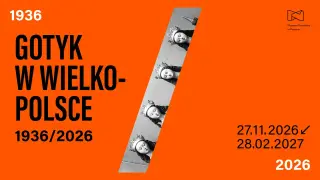
Gothic Art in Greater Poland 1936/2026
27 November – 28 February 2027 · Muzeum Narodowe w Poznaniu
- When
- 27 November – 28 February 2027
- Where
- Muzeum Narodowe w PoznaniuAleje Marcinkowskiego 9, Poznań
In brief
The exhibition contrasts two perspectives: an archival reconstruction of the 1936 exhibition and a contemporary presentation of Gothic works from Greater Poland. It shows how research and conservation have changed, and offers the chance to see sculptures and paintings that are usually housed in churches.
Full descriptionGood to know
- No Polish needed
- yes
The exhibition “Gothic Art in Greater Poland 1936/2026” tells the story of an exhibition held in our museum building in 1936. “Gothic Art in Greater Poland” was the first independent presentation of medieval sculptures and paintings at the Wielkopolskie Museum, and one of the first exhibitions of its kind in Poland. It tells how our view of medieval art has changed over the past 90 years, and offers a unique opportunity to see Gothic sculptures and paintings up close – including those usually housed in the churches of Greater Poland.
Student organisers of the exhibition during a study trip, Munich, 1935. Bottom row, from left: Kazimierz Kowalski, Szczęsny Dettloff, Kazimierz Alkiewicz, Halina Niklewicz, Katarzyna Pajzderska, Barbara Dembińska, Halina Waga. Top row, from left: Gwido Chmarzyński, Janusz Rejman, Przemysław Michałowski, Janusz Powidzki (crouching), Eugeniusz Krygier, Zdzisław Kępiński; Audiovisual Archive of the Faculty of Art Studies
Intellectual ferment and student friendship The exhibition “Gothic Art in Greater Poland”, held in 1936, was organised by art history students in their twenties at the University of Poznań, working under the guidance of their mentor, Rev. Prof. Szczęsny Dettloff. Passionate young researchers set out into the field in search of Gothic works. They visited more than 150 churches in the Poznań diocese, finding forgotten Gothic works in over 100 of them. A new chapter in research into the region’s medieval heritage began in this way.
Two moments in time, two perspectives on Gothic art The exhibition “Gothic Art in Greater Poland 1936/2026” has two parts: archival and artefacts. The first part takes us back in time to Greater Poland in 1936. It tells the story of the groundbreaking exhibition “Gothic Art in Greater Poland” and traces the objects’ post-war histories. It is a starting point for exploring how research methods, understandings of medieval art and approaches to heritage protection have changed. The second part lets the artefacts speak for themselves. Over the past ninety years, they have followed their own paths: some have been repainted, while others have, by contrast, been freed from thick layers of later alterations.
The exhibition “Gothic Art in Greater Poland”, 1936; Halina Niklewicz in the foreground in the third exhibition room; National Museum in Poznań Archive
Artefacts in worship, objects in a museum All the works presented in the exhibition were created for a specific purpose: to serve religion, explain the mysteries of faith and bring people closer to the truths recorded in the Bible. They were associated with particular sacred spaces and formed part of the rhythm of the liturgical year. In 1936, after the exhibition ended, the fate of most of them changed. The objects were moved from church interiors to museum galleries. This seemingly simple relocation, undertaken primarily to protect them, changed their status and the way they were used.
Catalogue of the exhibition “Gothic Art in Greater Poland”, 1936
Kościan, Pentecost (altarpiece); workshop of the Master of the Gościszowice Polyptych, 1507; made available courtesy of the Parish of the Assumption of the Blessed Virgin Mary in Kościan
The turbulent histories of Gothic treasures The exhibition brings together two different orders:
The artefacts that have remained in churches bear the marks of time, successive alterations, changing aesthetic sensibilities and adaptation to the transformed interiors of churches. They are “living” because they remain part of contemporary religious practice. The exhibition offers a rare opportunity to examine them up close. Objects held in museums: in a sense, their time stopped in 1936. Removed from their original context, they now function primarily as works of art, analysed by researchers in terms of style, form and authorship.
Today, with new knowledge and advanced conservation methods at our disposal, we can look at them afresh. Exhibition curator Dr Patrycja Łobodzińska: “Each artefact has its own biography. Some disappear, others return, col
Machine-translated from Polish.
Credits
This week in Poznań
 SONGS OF THE FOREST | SENIOR AT MUZAKino Muza w Poznaniu - SALA 1, Poznań
 Our RevolutionKino Muza w Poznaniu - SALA 2, Poznań
 Songs of the ForestKino Pałacowe - Sala 2 - Audiowizualna, Poznań
Source: Muzeum Narodowe W Poznaniu, data retrieved . Details may change, so check them with the organiser.