Actions on Houses
on until 3 January 2027 · Galeria Miejska Arsenał
- When
- on until 3 January 2027
- Where
- Galeria Miejska ArsenałStary Rynek 6, Poznań
- Admission
- Free admission
In brief
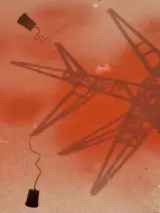
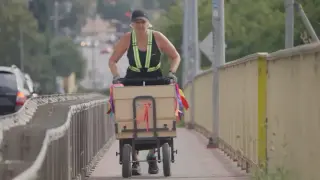
Aleksandra Kubiak’s project explores the idea of home as a physical, emotional and memory-laden space. The exhibition centres on the film “A House to Carry” and an object made up of 64 plaster bricks: a work about carrying, loss and the construction of place.
Full descriptionGood to know
- No Polish needed
- yes
Aleksandra Kubiak
Polish Sign Language interpretation at the opening: Karolina Bocian
Aleksandra Kubiak’s exhibition Actions on Houses centres on the idea of home, understood not only as a physical space, but also as an emotional state, a community, memory and the body. The artist explores how home is constructed through everyday experiences such as being wrapped up, warmth, the rhythm of rocking and building relationships. Interwoven with the categories of knowledge and architecture, these ideas create a map of intimate meanings in which the private meets the social and political. The film A House to Carry, made especially for the Poznań exhibition, attempts to capture what is conveyed not only through stories, but also through the body, emotions and gestures.
Kubiak builds her home through gestures of reduction rather than accumulation. A House to Carry can contain only what truly constitutes the idea of home. In her new film, the artist considers what home is as a physical, emotional and genetic space; she shows how we carry it within us, even when we can no longer build it. It is also a road film, a record of a walk, of time spent tired, of slowly traversing the landscape, and of the effort required to push a heavy object symbolising home from her studio in Zielona Góra to the gallery in Poznań. This seemingly irrational gesture restores meaning to everything that has lost its value in today’s culture of speed. The action lies somewhere between fantasy and reality. It materialises the dream of having a place of one’s own, while also reminding us that this place can be lost, abandoned or moved. After all, a home can be built, but it can also be lost. One can have no home, remember one, or try to take it along. It is therefore hardly surprising that the artist, walking along the way, was seen by people she met as homeless and mad. Here, the effort does not lead to a destination in the simplest sense. It becomes the meaning itself. The time it takes to travel the road, the weight of the object, the body’s fatigue—all of these are integral parts of the artistic action. Home is no longer an image. It is a burden that must be carried, dragged or pushed ahead of us.
The exhibition’s central object, A House to Carry.1–64, consists of sixty-four small plaster bricks arranged on a wooden pallet. The bricks become the imagined building material of a private space, a home that can be assembled, dismantled and taken along. The meaning of the exhibition Actions on Houses balances between the private and the public, between gestures of care and the need to belong. It is an attempt to understand home as a dynamic, fragile structure that we are constantly building within ourselves, between one another and in relation to the world.
An integral part of the exhibition is an accompanying publication of texts written by the artist over the years, which have been created alongside her successive works. The author has chosen to collect them in a single publication, although from the outset they were not intended solely to be read. They were also meant to be heard during performances by the artist. Written in the first person, they suggest a record of a confession, an interior monologue that allows the author to define her own place in the world, gather strength and organise her thoughts. This is an exceptionally direct, realistic account, free of literary affectation, and yet powerful precisely because of its uncompromising energy. The texts are multilayered, but never become obscure. Their strength comes from the precision with which they observe both reality and the author’s own emotional states. They can be read as a stream of consciousness: a sequence of thoughts, recalled images and memories, and sudden associations. Kubiak’s texts are not merely a record of personal experience. Like the exhibition as a whole, they become a space where the private meets what is shared: memory, experience, fear, the body, family, history and the need for closeness. The exhibition is also about searching for one’s roots, returning to family microhistories and to dramatic experiences from the past that affect subsequent generations.
Actions on Houses therefore does not present an image of home as a stable order. Here, home is more of a question. Something we try to build, move, recover, or sometimes merely imagine. Perhaps this is precisely why its most important form turns out to be movement: the road, the body, the voice, memory and work undertaken without any practical reason. Home does not have to be a place one can return to. Sometimes it is what we carry with us.
Marek Wasilewski
Co-financed by the Minister of Culture and National Heritage from the Culture Promotion Fund, a state-purpose fund
Machine-translated from Polish.
Credits
This week in Poznań
 La PerraKino Muza w Poznaniu - SALA 3, Poznań
 SONGS OF THE FOREST | SENIOR AT MUZAKino Muza w Poznaniu - SALA 1, Poznań
 Our RevolutionKino Muza w Poznaniu - SALA 2, Poznań
Source: Galeria Miejska Arsenał, data retrieved . Details may change, so check them with the organiser.