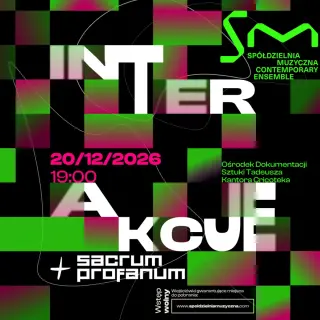
Spółdzielnia Muzyczna: Interactions_20.12 | Concert
Sunday 20 December, 19:00–20:15 · sala teatralna, Cricoteka, ul. Nadwiślańska 2-4, Kraków
- When
- Sunday 20 December, 19:00–20:15
- Where
- sala teatralna, Cricoteka, ul. Nadwiślańska 2-4, KrakówNadwiślańska 2-4, 30-527, Kraków
In brief
Spółdzielnia Muzyczna brings together compositions by Panayiotis Kokoras and Tristan Murail with the Polish premiere of a work by Agata Zubel. The programme explores new sounds and relationships between sound, gesture and matter, with the music performed in a space associated with the work of Tadeusz Kantor.
Full descriptionGood to know
- No Polish needed
- yes
On the programme
- Panayiotis Kokoras – Friction
- Tristan Murail – Garrigue
- Agata Zubel – Multi-Headed Dragon
Interactions on 20 December 2026 at Cricoteka, taking place as a supporting event of the Sacrum Profanum festival, will be a concert like no other. It will bring together worlds, aesthetics and contexts that might seem far removed from one another. Cricoteka, a space inextricably linked with the work of Tadeusz Kantor, will become a meeting place for contemporary music, art, experimentation and the constant search for new forms of expression. In surroundings where the boundaries between different art forms have long been called into question, music exploring the relationships between sound, gesture, matter and imagination will be performed. Music commonly described as contemporary, even though it is already, at least in part, historical music. Programme Panayiotis Kokoras – Friction for flute, bass clarinet, cello and piano (2001) Tristan Murail – Garrigue for bass (or alto) flute, viola, cello and percussion (2008) Agata Zubel – Multi-Headed Dragon for chamber ensemble (2026) – Polish premiere About the event The first part of the evening will feature works by composers whose musical inspirations are, in different ways, linked to the Mediterranean cultural sphere. Friction by Greek composer Panayiotis Kokoras was written 25 years ago. Its starting point is the sonic properties of friction. The work consists of three main sections. The first is harmonic and vibratory in character; the middle section draws on the energy of the sonorist aesthetic and leads seamlessly into the final section, which is characterised by a more linear structure with recurring gestures. The evolution from one idea to the next is the most important and, at the same time, the longest element of the composition. Its harmonic foundation is a sequence of six chorale-like chords, used throughout the work in various transformations – including transposition, superimposition and the development of material. In addition, electroacoustic techniques such as filtering, shifting the harmonic spectrum, distortion and looping are modelled using techniques suited to acoustic instruments. French composer Tristan Murail, one of the most important exponents of spectral music, takes listeners into a completely different sound world in his 2008 work Garrigue. The composition belongs to the Portulan cycle, whose title refers to old sea charts used by sailors to navigate. The cycle’s individual works form a kind of musical autobiography, evoking places, memories and experiences that are particularly important to the composer. The titular garrigue is a type of vegetation characteristic of the Mediterranean landscape, made up of low shrubs and aromatic herbs. In his music, Murail evokes the landscape of Provence – sun-warmed stones, dry air and an apparent silence filled with the ceaseless vibration of cicadas and crickets. These impressions give rise to a subtle, shimmering sound world in which timbre, resonance and the interweaving of sounds become the most important elements of the musical narrative. Garrigue is therefore not so much a literal picture of nature as an attempt to capture its inner energy, constant movement and the richness hidden in an apparently uniform sound space. The second part of the concert will feature the Polish premiere of Agata Zubel’s latest composition, Multi-Headed Dragon, written especially for Spółdzielnia. In it, the composer presents the ensemble as a single organism made up of many different personalities – a multi-headed dragon. We can hear a musical, many-voiced organism in which individual instruments retain their own identities while also combining to form one complex entity. The parts overlap, enter into dialogue, clash and at times merge, creating the impression of a constantly changing structure with many ‘heads’. The titular dragon thus becomes a metaphor for the ensemble as a living organism – polycentric, unpredictable and sustained by the tension between individuality and community. In the traditional conversation accompanying the concer
Machine-translated from Polish.
Credits
This week in Kraków
 Royal Chopin Hall - Queen Classic CandlelightRoyal Chopin Hall, Kraków
 Miejsce Komedii – Cupid’s Arrow | Improvised Comedy ShowLastriko, Kraków
 Apteka – Garage PubGarage Pub, Kraków
Source: Cricoteka, data retrieved . Details may change, so check them with the organiser.